Launch checklist
Check the timeline and agree who owns each part of the study before launch.

Launch checklist
How to plan the timeline and assign roles
Timeline
You need to understand when the data is needed and why that timing matters. This affects method choice, makes it possible to plan research, and helps you stay in the business rhythm. Or, if there is no rush, it helps you plan properly and work comfortably.
Who can be responsible for what: product managers, designers, editors, analysts, and marketers
Think about who you will do the study with, who will be responsible for what, and what your own responsibility is. Research is always teamwork. It is important to involve people: if someone participates in business decisions but is not connected to the research, that becomes a problem rather than an advantage. And if resources are limited, think about whom you can ask for support.
Basic areas of responsibility are usually distributed like this:
- The product manager owns the task and then makes the business decision based on the research. They immerse you in the context, explain the business problem and their expectations, share questions and hypotheses, study the data and report, and discuss thoughts after the study.
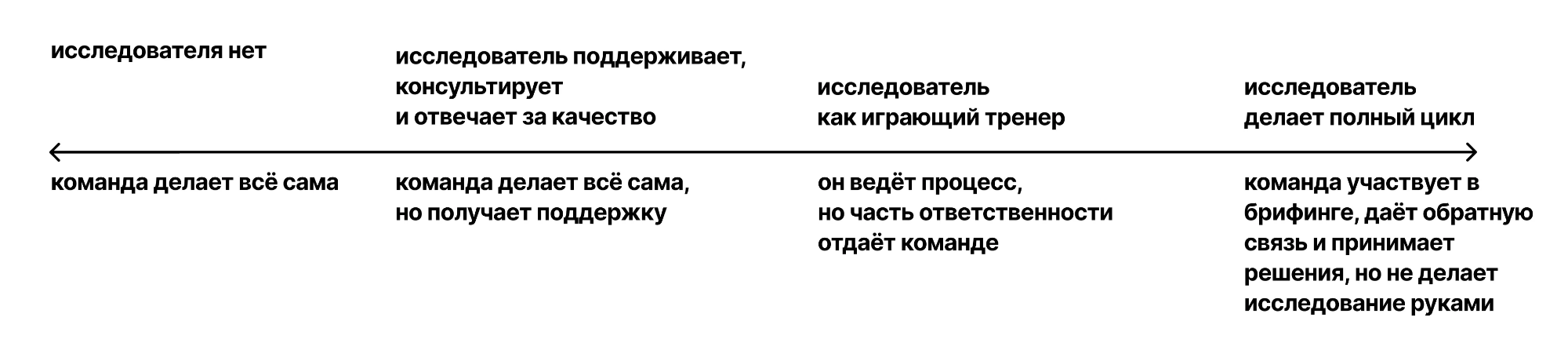
- The designer owns the design and makes decisions about it. They formulate questions and hypotheses for the test, define expectations, prepare prototypes and monitor their quality, participate in the research, and make design changes based on the results. Their involvement in the study may vary. When it comes to usability tests, designers increasingly run them themselves. This is convenient: the researcher does not need to be immersed in the details of the solution, the launch is faster, and the designer can make changes immediately without reports and retellings. The researcher’s role in this process is to provide tools, train the team, and help with conclusions if needed. But responsibility for the brief, launch, analysis, and decisions remains with the designer. “I am always happy when designers or product managers run tests on Pathway themselves. It reduces the time needed to transfer context and usually greatly increases motivation because the team sees feedback on their work. The researcher’s task is to provide the tool in advance and describe a clear process and guides so it is clear which methodologies to use in which cases and for which tasks. During the test, the researcher answers questions, helps with methodology and complex moments, and reviews the test and result analysis. Research democratization enables the research team to work more effectively, and design and product teams to interact more with user feedback.” Marina Suslova, Head of Research, Zvuk.
- The editor owns the text and makes decisions about it. They formulate questions and hypotheses, define expectations, write copy, and make sure that when variants are compared, only the tested attribute changes. After the study, they make edits. Like designers, editors can research their own texts themselves.
- The analyst owns work with data and helps strengthen research conclusions. They can be a source of hypotheses and questions, and motivate the product manager to check behavior visible in product analytics. After the study, they evaluate release results, enrich insights with analytics data, and help ground conclusions at larger volumes, which makes prioritization easier.
- The marketer owns product communication and can be a source of research tasks. For example, NPS results may show that the app’s inconvenience reduces people’s willingness to share it with friends. This insight becomes a reason to run research together with the product manager. Another common case is a drop in landing-page registration conversion. Marketing usually tracks this metric and may request a check of whether users really understand who the product is for and whether they find everything they need on the page to register.
The composition of research participants can vary greatly. In some companies, it is important to involve Sales; in others, developers or AI/ML specialists participate more actively. It all depends on context: roles may differ, but the main thing is that the team helps each other and moves the research forward together.
The company’s maturity level and available resources determine how actively the researcher, or the person who has taken on the study, can be involved in research, and what role the rest of the team takes.