
Research Ops
Assess your team’s maturity and build a sustainable research practice.

Research Ops
How to make research part of your team’s work
Research creates value only when decisions are made based on its results. For this to become normal, two things are needed: trust in the results and a system that reinforces success.
Next, we will look at steps for integrating research. Their order is not universal. Choose what seems most suitable for your situation and context.
Assess what situation you are in
UX Research Maturity shows how deeply research is embedded in business processes, which methods are suitable at the current stage, and which steps will help you move forward.
There are different maturity models, for example from NN/g or KEIKENDO, which is good for getting started. It shows what place research occupies in a company:
- Low maturity: research is conducted occasionally and depends on enthusiasts, or it is not conducted at all. Today, many companies already have research in one form or another. Yes, you will need to invest time in training and show new approaches in practice. But the most important thing is that interest in the topic already exists, and that is an excellent foundation. From there, everything depends on time and leaders’ readiness to move toward greater customer centricity.
- Medium maturity: research is embedded in team processes, but its influence on strategy is limited.
- High maturity: research systematically manages risks and shapes business decisions.
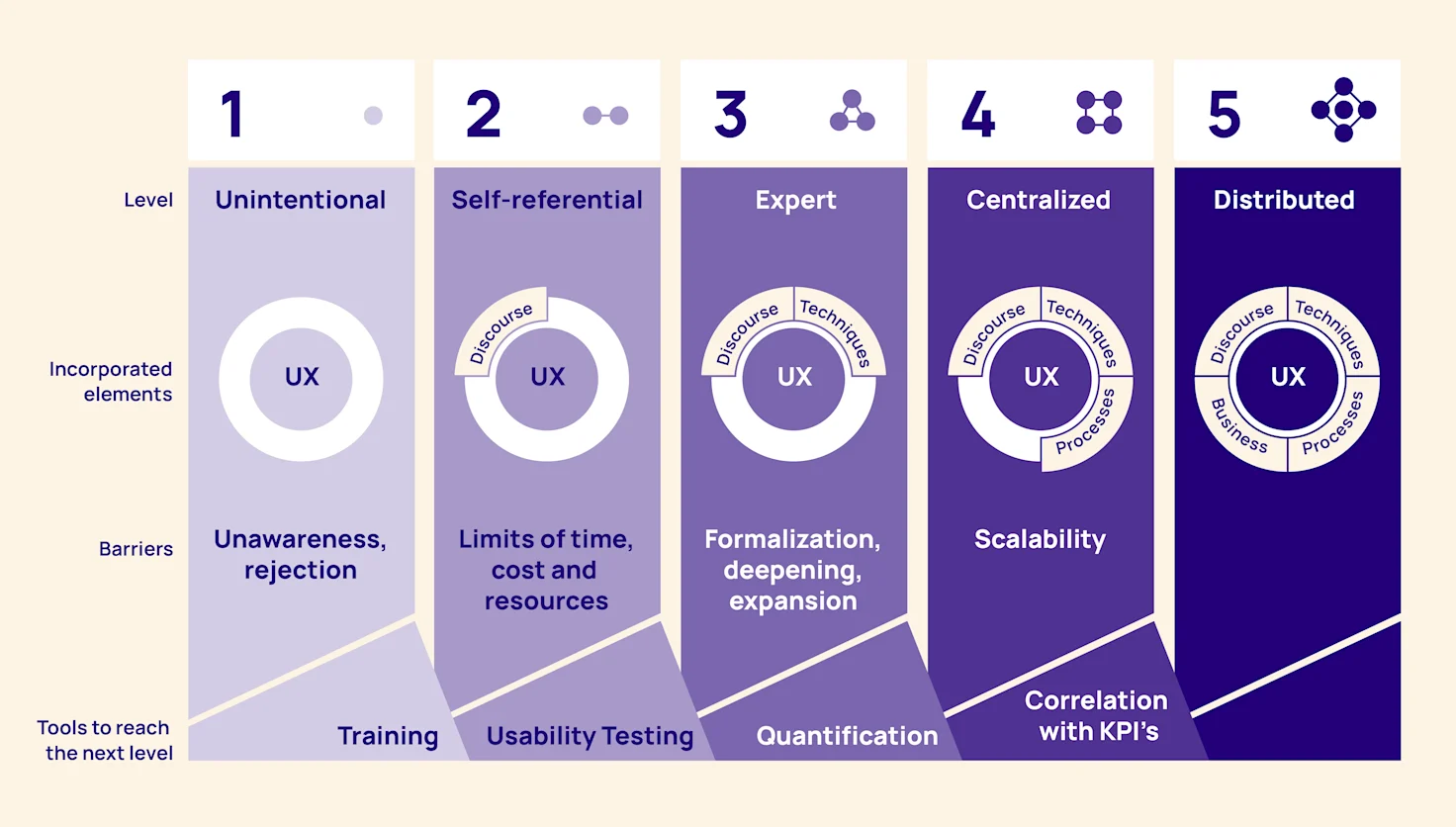
KEIKENDO maturity matrix
| Unintentional | Self-Referential | Expert | Centralized | Distributed | |
|---|---|---|---|---|---|
| What it looks like | UX | UX + discourse | UX + discourse + methods | UX + discourse + methods + processes | UX culture + discourse + methods + processes + business |
| Key barriers | Lack of awareness, rejection | Time, budget, and resource constraints | Formalization, deepening, expansion | Scaling | |
| Tools for advancement | Training | Usability testing | Quantitative methods | Linking UX metrics to KPIs |
How to read the maturity model
| Unintentional | Self-Referential | Expert | Centralized | Distributed |
|---|---|---|---|---|
| UX is not considered a separate practice. It emerges incidentally — as a by-product of business or IT tasks. | The product is designed “for ourselves”: users are idealized, and real data is barely used. UX appears in external communications but remains a slogan. | A dedicated UX specialist or small UX team emerges within the company. Tests are rare and not always methodologically rigorous. | There is a full UX team (information architecture, interaction design, usability). UX techniques are systematic and embedded in the process. | UX has the same organizational standing as marketing and finance. It is embedded in the culture and involved at every stage: discovery → design → development. |
Nasdaq’s maturity model is more detailed. It works well for planning the next steps to raise the maturity level.
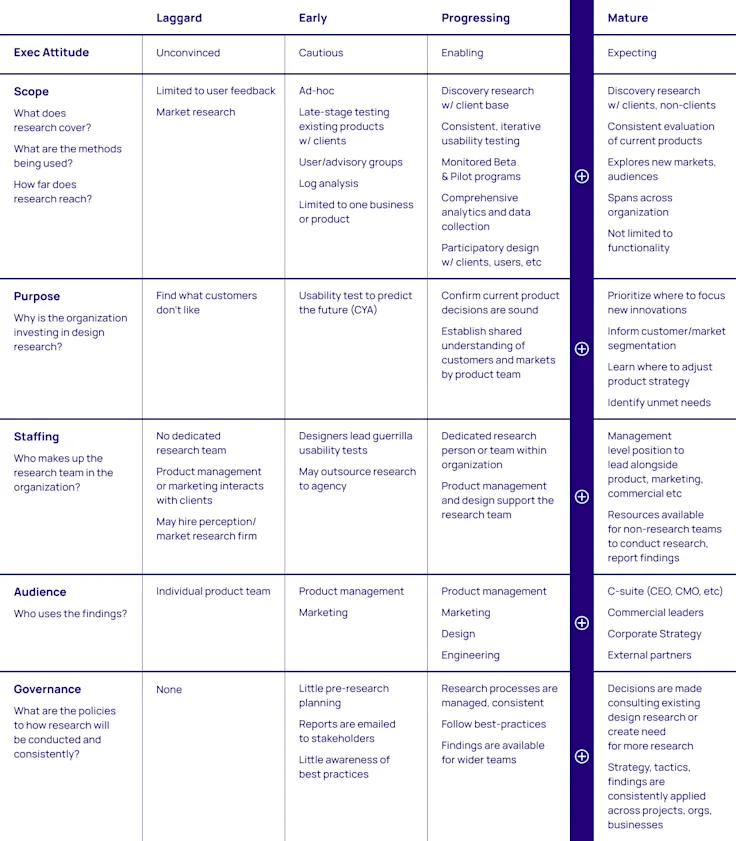
Step 1. Earn trust through practice
At the beginning, you do not need to convince everyone with presentations and theory. It is better to show the effect through concrete examples.
Start with small studies that are visible to the business, and expand the scale step by step
They are easier to run and quickly show results. If after a test users contact support less often, conversion grows, or the task is completed faster, stakeholders themselves start saying “yes” to new research.
Find allies
Look for people who are ready to support research: from partners-in-crime, people who believe in research as much as you do, to those who at least do not reject it. These may be product managers, marketing, sales, support, development, and other people in the company. The main thing is that together you can demonstrate value in practice.
Involve stakeholders as observers
This lets them see for themselves where users run into difficulties, and they will support improvements faster. The main thing is not to overload them with details.
Show ROI through real cases
ROI (Return on Investment) is a measure of return on investment in research. It shows how much value, savings, or additional revenue the resources invested in research generated.
Research can surface risks before launch, while the team can still change course. To show its contribution, record which decision changed after testing, which metric the team tracked, and what happened after launch. If you calculate ROI, state the time period, costs, evidenced financial benefit, and the assumptions behind attributing that benefit to research.
Step 2. Embed yourself in business processes
Once trust has been earned, it is important to turn research from one-off work into part of the system.
Consider the business context
What matters most at the moment: release speed, release quality, finding product-market fit, maintaining market position, or something else? This will help you understand how to embed research so that it brings value, does not slow the team down, and keeps the right balance between speed, quality, and money.
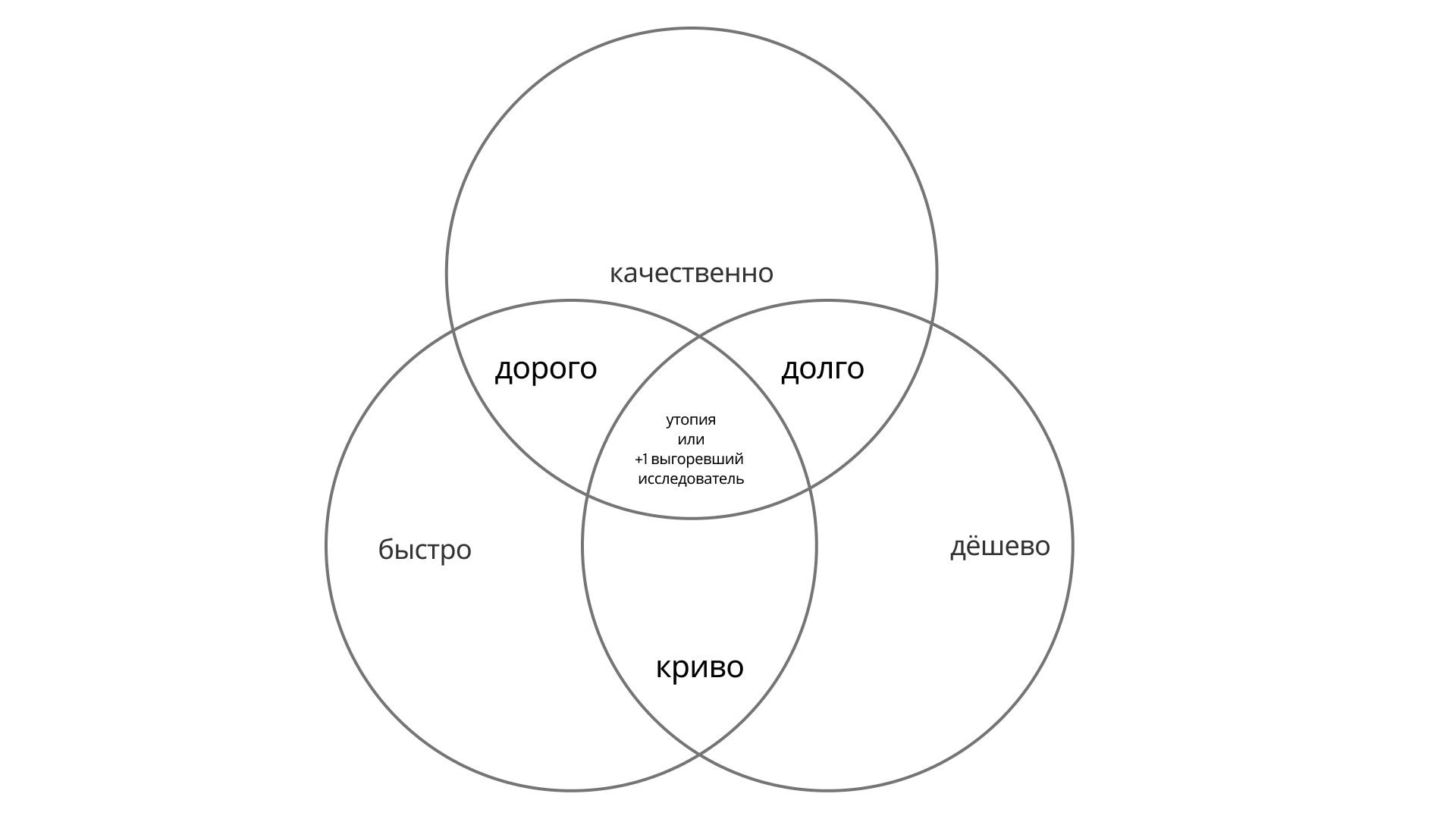
What should you do if you are the first researcher and there are many teams? There is no single correct answer. But there is a plan that can help you orient yourself:
- understand the business context and find the balance between speed, quality, and resources
- clarify expectations with your manager and key stakeholders
- look at the company’s strategic and tactical plans
- define what exactly you consider important. This point is key: you are the one who sets the research standard. But form your opinion based on everything listed above
Build relationships and trust with stakeholders
This is not a bonus, but a working tool that increases the value of research. Relationships provide understanding of business priorities, access to data and users, help align the focus, and make it easier to implement insights in work.
Teach the value of UX research
The more clearly stakeholders see how research helps their goals, the more willingly they support it.
Step 3. Strengthen the foundation
When the team has already seen the value of research, the next step is to make it not one-off, but embedded in product life. This means defining the rules of the game, building a system, and enabling knowledge to accumulate.
A researcher is not a “support service” for the product, but a partner in decision-making. To make that work:
Organize cross-functional interaction. A good practice is to make research not only for researchers:
Step 4. Set up democratization
Research democratization is useful only where there are clear boundaries. Giving people a tool does not mean they know how to use it, and a one-day workshop does not turn a stakeholder into a researcher. If the system is not built, instead of value you get “research theater”: insights stop being taken seriously, and research becomes imitation.